

BlueCycle: restoring reefs, transforming sargassum, and empowering communities for healthier coastal ecosystems and a Circular Blue Economy in the Dominican Republic.
Project Budget
250,000.00 USD
Does the project benefit marginalized groups?
Yes
Type of Investment
Grant
Project Description
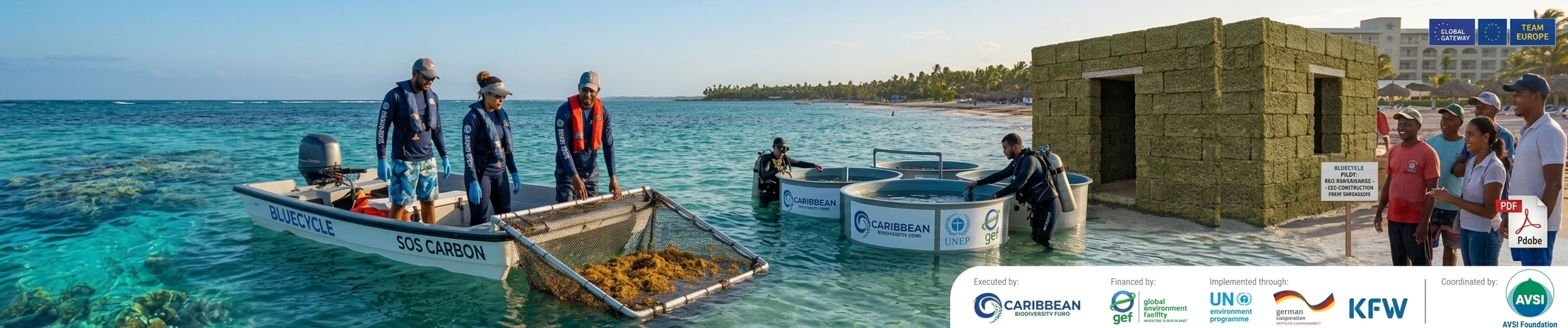
The BlueCycle project addresses coastal degradation and marine pollution in the Dominican Republic through an integrated circular blue economy approach. Focusing on the vulnerable Bávaro–Cabeza de Toro coastal zone, the project combines coral reef restoration, proactive offshore sargassum interception, biomass transformation into eco-friendly construction materials and organic fertilizers, and community capacity building to build long-term ecosystem resilience.
Led by the AVSI Foundation in partnership with Bávaro Reefs, EcoServices, and SOS Carbon, the initiative establishes land-based coral and sea urchin rearing laboratories to improve the management of at least 5 hectares of marine ecosystem. Simultaneously, it deploys offshore collection technology to intercept 250 tons of sargassum biomass before reaching the shore, preventing environmental and socio-economic degradation. The biomass is transformed into 500–1,000 sargassum blocks to construct a pilot community "Sargahouse" and 300 liters of organic fertilizer. By training 180 direct beneficiaries (50% women) and leading regional multi-stakeholder workshops, BlueCycle delivers a replicable framework for a sustainable blue economy in the Caribbean.
Project Sector
- Coastal Protection and Restoration
Target Beneficiaries
- Coastal Households and Vulnerable Populations
Project Location
- Dominican Republic
Project Partners
Native Language
Context / Problem Description
The Caribbeans are increasingly affected by massive influxes of pelagic sargassum seaweed, which accumulate along coastlines and generate significant environmental, social, and economic challenges. When sargassum reaches the shore and decomposes, it releases harmful gases, deteriorates water quality, damages coastal ecosystems including coral reefs, and negatively impacts tourism and local livelihoods. Coastal areas in the Dominican Republic, such as Cabeza de Toro (Punta Cana), are characterized by high ecological value, including proximity to coral reef systems and coastal habitats, as well as strong dependence on tourism and coastal resources. However, in some areas such as Cabeza de Toro, coastal management remains limited, with sections of the coastline not regularly cleaned or managed by hotels, leading to the accumulation of sargassum and increased environmental pressure. There is currently limited capacity for early interception and sustainable management of sargassum, resulting in reactive and often environmentally harmful practices such as beach removal using heavy machinery. At the same time, coral reef ecosystems in the area are under increasing pressure due to climate change, pollution, and unsustainable coastal development, resulting in declining live coral cover and reduced ecosystem resilience. Recent assessments and ongoing work by Bávaro Reef highlight critical ecological imbalances, including high macroalgal cover, low coral recruitment, and the near absence of an urchin species (Diadema antillarum) which is essential for controlling algal growth and supporting reef recovery. Several barriers hinder an effective response. Existing reef restoration efforts often face challenges in ensuring long-term impact, as interventions are not always accompanied by continuous monitoring, protection, nor by any community awareness and involvement in the process. There is also limited technical capacity and infrastructure for offshore sargassum collection, lack of coordination among stakeholders, and underdeveloped circular economy solutions to valorize sargassum biomass. While private sector actors and local communities are directly affected, their involvement in sustainable management practices remains fragmented. This initiative addresses these interconnected challenges through an integrated approach combining ecosystem restoration, proactive sargassum management, circular value chain development, and community engagement. By restoring reef ecological functions through coral propagation, sea urchin recovery, and algal control, intercepting sargassum before it reaches the shore, and transforming biomass into valuable products, the project aims to reduce environmental degradation and strengthen coastal resilience while promoting sustainable blue economy opportunities.
Project Approach
The project builds on the existing experience, technical capacities, and local presence of the involved partners, ensuring both feasibility and strong potential for scale-up and replication. Bávaro Reefs has extensive experience in reef restoration and long-term ecological monitoring in the Punta Cana area, including Cabeza de Toro, where it has developed in-depth knowledge of reef conditions and restoration practices. Building on recent assessments and ongoing work, this provides a strong foundation for implementing context-specific and scientifically grounded interventions, including integrated approaches such as coral propagation, sea urchin recovery, and algal control, alongside monitoring measures to ensure long-term impact. SOS Carbon brings proven expertise in offshore sargassum collection in Punta Cana, enabling the rapid deployment of collection systems and the development of a trained local workforce capable of responding to surges in sargassum influxes, supported by targeted training activities that strengthen local capacities and enable scalable and adaptive operations over time. EcoServices contributes established experience in waste management and material transformation, including the integration of recycled materials into construction processes, expanding the existing circular economy practices to include sargassum-based products, supported by real-life testing and demonstration. The project adopts an integrated pilot approach, combining reef restoration, proactive sargassum management, and circular value chain development, while strengthening community capacities and stakeholder coordination through the establishment of a simple coordination mechanism of multi-stakeholder meetings and targeted engagement activities. By testing solutions under real conditions, and by engaging stakeholders at local and regional levels, the project will generate practical and replicable models, designed to be scaled to other coastal areas of the Dominican Republic and the wider Caribbean, contributing to long-term sustainability and attracting future investment in blue economy solutions.
Project Objective
The action is expected to generate measurable environmental and socio-economic benefits by addressing the root causes of coastal degradation and promoting integrated blue economy solutions. Environmentally, reef restoration activities will contribute to increased live coral cover, improved reef health, and enhanced ecosystem resilience through reef restoration and protection of at least 5 hectares of coastal and marine ecosystems. The introduction of assisted coral propagation and continuous monitoring will ensure that restoration efforts are sustained over time, overcoming common limitations of short-term interventions. Offshore collection of sargassum will reduce the accumulation of biomass along the coastline, preventing ecosystem damage and improving water quality in sensitive coastal areas, reinforcing the work that was conducted directly in the reef. From a socio-economic perspective, the project will strengthen local capacities and create opportunities for community participation in sustainable coastal management. By engaging local actors in sargassum collection, processing and downstream activities such as drying and application of fertilizer, the project will support inclusive value chains and promote more balanced participation, including increased involvement of women in post-harvest activities. The development and testing of circular solutions, including sargassum-based construction materials and organic fertilizers, will demonstrate the potential of transforming an environmental challenge into an economic resource. By validating these applications in real contexts, the project will contribute to unlocking scalable blue economy opportunities and attracting future investment. Overall, the project will contribute to more resilient coastal ecosystems, improved livelihoods, and strengthened collaboration among stakeholders, laying the foundation for long-term sustainable management of marine and coastal resources in the Dominican Republic.
Anticipated Outcome
The BlueCycle initiative is designed to deliver immediate, high-impact environmental, socio-economic, and technical outcomes in the Dominican Republic (specifically within the Bávaro–Cabeza de Toro coastal zone). By integrating ecosystem restoration, proactive pollution management, circular economy innovation, and community capacity building, the project will achieve the following major outcomes: 1. Ecosystem Protection and Coral Reef RestorationImproved Coastal Management: At least 5 hectares of sensitive marine and coastal ecosystems within the Bávaro–Cabeza de Toro Local Marine Management Area (LMMA) will be placed under improved conservation and management practices. Enhanced Reef Resilience: Through the establishment of a land-based laboratory featuring 24 coral larval settlement tanks and 6 sea urchin rearing tanks (expanding an existing baseline), the project will produce biological material necessary for large-scale reef recovery. Biological Control & Restoration: Assisted reproduction and deployment of Diadema antillarum (herbivorous sea urchins) combined with targeted coral outplanting and manual macroalgae removal will restore natural grazing dynamics, reduce algal cover, and increase live coral cover. 2. Proactive Marine Sargassum InterceptionOffshore Biomass Collection: Deployment of 1 operational Littoral Collection Module (LCM) system will intercept floating sargassum at sea before it reaches fragile coastlines. Preventing Ecosystem Degradation: Collecting at least 250 tons of sargassum biomass over a minimum of 30 operational days will significantly reduce toxic H₂S gas emissions, water quality deterioration, and physical smothering of coral reefs and beaches. 3. Circular Blue Economy & Value Chain DevelopmentSargassum-Based Construction Materials: The installation and calibration of a pilot processing unit will produce 500 to 1,000 sargassum-based construction blocks. These blocks will be validated through laboratory tests and demonstrated via the construction of 1 pilot "Sargahouse" model building in a vulnerable coastal community. Agricultural Valorization: The establishment of a dedicated biomass drying and preprocessing system will enable stable, year-round production of organic fertilizer. At least 300 liters of sargassum-based fertilizer will be tested across 2 to 3 pilot sites, including hotels and golf courses. 4. Community Empowerment, Capacity Building, and Stakeholder GovernanceDirect Beneficiaries & Inclusivity: Reaching at least 180 direct beneficiaries, with strict gender-equity targets (50% women): 30 adult community members reached through 10 environmental awareness workshops. 120 students reached across 4 local schools through 24 marine education modules. 30 individuals technically trained in sustainable sargassum collection, logistics, and handling, creating a skilled local workforce. Gender Integration: Women’s participation will be expanded into traditionally male-dominated sectors, specifically through post-harvest drying, biomass preprocessing, and value-addition activities. Multi-Stakeholder Alignment: Strengthening regional coordination between local authorities, the hotel association (ASONAHORES), academic initiatives (SARGARD), and coastal communities through 2 dedicated multi-stakeholder workshops and ongoing dialogue spaces.
By clicking below, the Project Owner will be notified of your interest in their project and you can continue the conversation with them via email. You will now be able to see this project in your Dashboard.
Connect NowJoin the largest maritime innovation hub in the Caribbean
Chart a course towards a sustainable future with us.
Get in Touch